From the early 2000s to around 2012, SEO was mostly a numbers game. You could repeat a phrase like “best SEO tips” twenty times on a page, stuff it in the meta tags, and watch it rank. Search engines rewarded repetition because they didn’t really understand language — they just matched patterns.
That all changed when Google started teaching its algorithm to read more like a person. Three major updates flipped the script:
- Panda (2011): Cleaned up thin, duplicate, and spammy content. It rewarded useful, original pages and punished keyword-stuffed ones.
- Hummingbird (2013): Introduced true semantic understanding. Instead of focusing on individual words, it began interpreting the intent behind a search.
- RankBrain (2015): Added machine learning. It helped Google connect new or unseen phrases to known concepts — essentially linking words to entities in the Knowledge Graph.
These updates have transformed SEO from a word-matching contest into a meaning-matching system — what we now call semantic SEO. It’s built around three key ideas: entities, attributes, and context. In this guide, we’ll focus on the first one — entities.
Entity SEO is the next logical step: optimizing your content so Google instantly knows what you’re talking about, who it helps, and how it relates to other ideas in its knowledge network.
This guide, Entity SEO Explained, breaks down what entities are, how they differ from keywords, and how you can use them to make your content clearer to both readers and search engines.
What Is an Entity in SEO? (Entities for Beginners)
An entity is something real that Google can identify, define, and connect to other facts — a product, brand, ingredient, or concept that exists beyond just a keyword.
Think about the AeroPress coffee maker. When someone searches for it, Google doesn’t just see the words “coffee press” or “manual brewer.” It recognizes AeroPress as a specific product made by Aerobie, linked to entities like coffee brewing, espresso alternatives, barista tools, and even World AeroPress Championship.
Because that entity is clearly mapped in Google’s Knowledge Graph, content that describes how it works, what it’s used for, and how it compares to similar tools has a much better chance of being understood — and ranked — correctly.
That’s what Entity SEO is really about: helping search engines grasp meaning, not just matching terms. When you write about a product like the AeroPress, you’re not just targeting “coffee maker” as a phrase; you’re building a clear network of context — materials, use-cases, features, and brand connections — that mirrors how the product exists in the real world.
It comes down to this: define the thing, describe what matters, and connect it naturally to related ideas. The more complete that picture, the easier it is for Google (and readers) to understand exactly what you mean.
What is a Knowledge Graph?
To understand how entities connect, it helps to start with knowledge graph basics — the system Google uses to organize information about the world.
The Knowledge Graph, introduced by Google in 2012, works like a giant digital map. Every entity — whether it’s a person, product, place, or concept — sits as a point on that map, connected to others through relationships. These links tell Google what something is, what it does, and how it relates to other things.
In other words, it lets Google answer questions and rank pages based on relationships, not repetition.

When your content mirrors how information is structured in the Knowledge Graph, it becomes easier for Google to place — and trust — it.
How the 4 Types of Entities Work in the Knowledge Graph
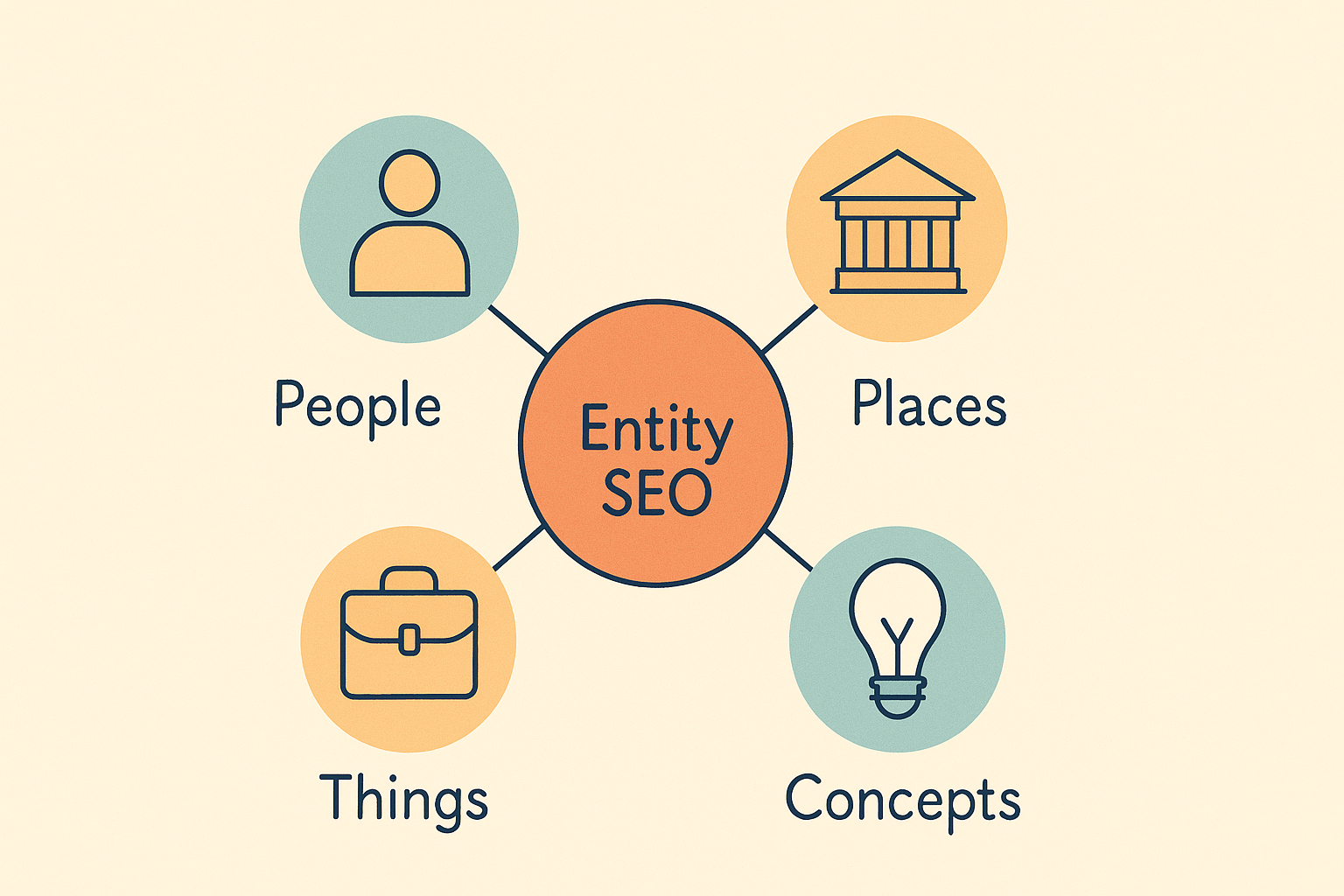
Google’s Knowledge Graph connects names, services and products through contextual info. The four main types that are the foundation of entity based SEO include:
| Entity Type | Example | Role in the Knowledge Graph | How It Connects |
| Person / Organization | James Hoffmann (person) / Aerobie (organization) | Adds identity, credibility, and origin. | James Hoffmann is a coffee expert who uses and reviews products made by Aerobie. |
| Place | London | Provides location and context. | London is where James Hoffmann runs his coffee company and creates content about brewing. |
| Thing / Product | AeroPress coffee maker | Represents a physical entity people search for or use. | The Aeropress is manufactured by Aerobie and featured in Hoffmann’s brewing tutorials. |
| Concept / Idea | Home coffee brewing | Explains the topic or intent behind the search. | Connects all entities under one meaningful theme — how to brew better coffee at home. |
Together, these entities form a simple but powerful map of meaning:
James Hoffmann → brews with → Aeropress → manufactured by → Aerobie → based in → London → linked to the idea of → home coffee brewing.
This is what Entity SEO Explained looks like in practice — defining what things are, showing how they relate, and giving Google a complete picture it can trust and rank.
What Is an Entity Match and Why It Matters for Rankings?
When Google fully understands what your page is about, it can link your content to the right concept in its Knowledge Graph — this connection is called an entity match.
An entity match happens when Google’s understanding of your content aligns perfectly with a known entity in its database. In plain terms, it means Google gets it. It knows the topic, the intent, and how your page fits within the bigger network of related ideas.
Here’s how it works in practice:
| Example | What Google Sees | Result |
| Page Title: “How to Brew with an Aeropress” | Mentions and context align with the known entity Aeropress (product). | Google connects the article to the Aeropress entity in the Knowledge Graph, improving relevance for brewing-related searches. |
| Page Mentions: “Aerobie invented the Aeropress in 2005.” | Links two entities: Aerobie (organization) and Aeropress (product). | Strengthens the relationship between entities and helps confirm topical accuracy. |
| Supporting Info: “Popular among home coffee brewing enthusiasts.” | Adds the concept home coffee brewing (idea) and its user intent. | Expands semantic coverage and aligns the page with broader queries around coffee brewing methods. |
When these connections are consistent — in your wording, schema, internal links, and context — Google doesn’t just see a keyword; it sees proof of understanding. The clearer your entities and relationships are, the more confidently it can match your page — and the higher it’s likely to rank. I explore the difference between keywords and entities in detail in Forget Keywords – Google Cares About Meaning Now.
Entities for Beginners – FAQ
A weak entity is one that lacks clear context or connections. For example, writing about “filters” without specifying whether you mean coffee filters, camera filters, or air filters creates ambiguity. Google can’t confidently map it in the Knowledge Graph, so it treats it as low-value or unclear content.
Keywords are strings of text people type into search bars, while entities are the real things those words refer to — like people, products, or ideas.
For instance, “coffee maker” is a keyword, but “Aeropress” is an entity. Keywords tell Google what was typed, entities tell it what was meant.
You can find relevant SEO entities by analyzing how Google describes your topic in tools like Google’s NLP API, TextRazor, or InLinks. You can also use Wikipedia, Knowledge Panels, or even Google Search itself — the “People also ask” and “About this result” sections often reveal recognized entities for your subject.
For entities for beginners, start by identifying the real-world people, products, and concepts your content naturally connects to.
The 80/20 rule in SEO means that 80% of your organic results often come from 20% of your content. Instead of chasing hundreds of random keywords, focus on the few pages or entity-based topics that drive the most trust, links, and engagement. Strengthening those key pages amplifies your site’s overall authority.
Leave a Reply